01
You keep explaining things it should already understand.
RESET
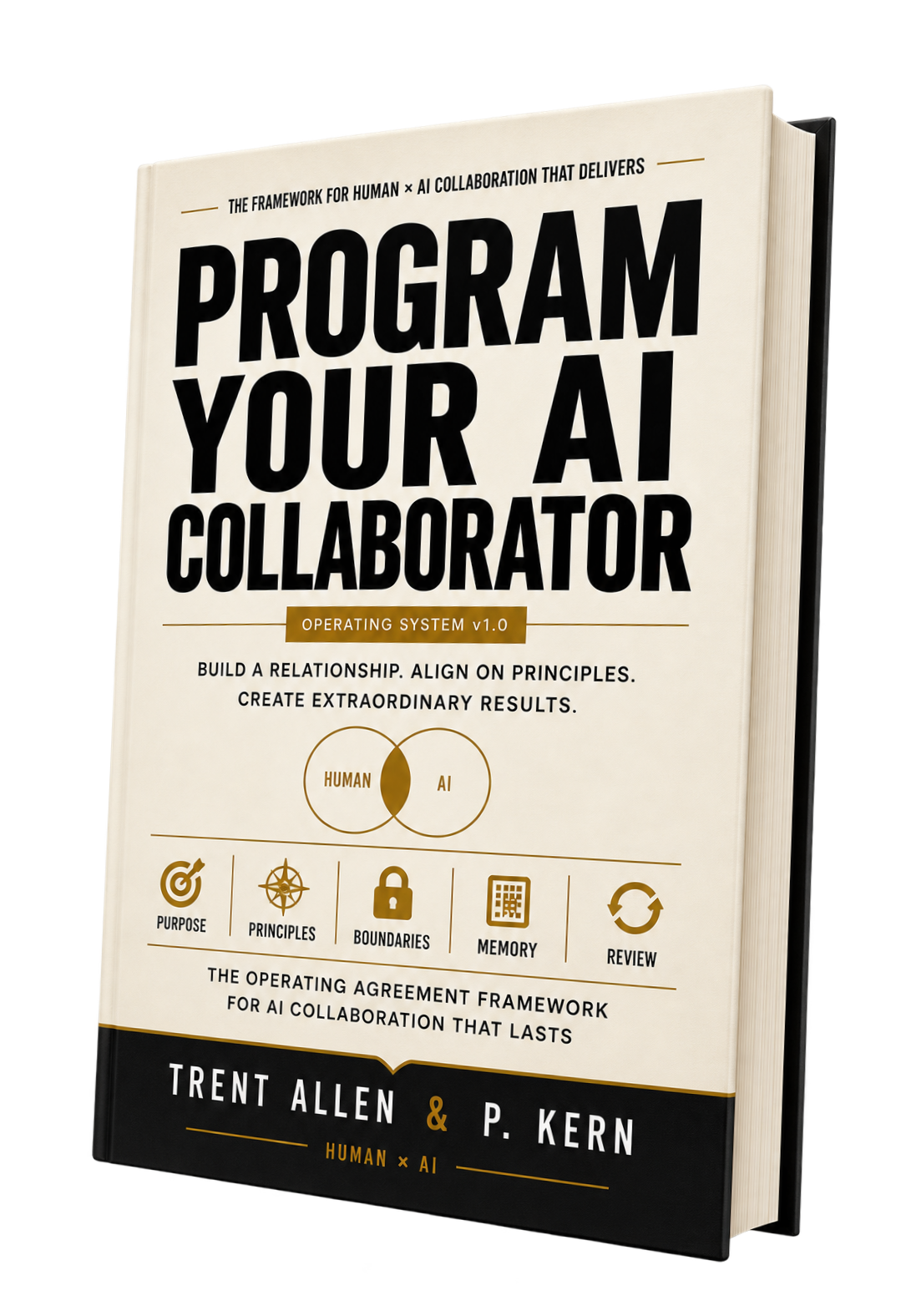
 Program Your AI Collaborator
Stop prompting a tool. Start building a working relationship.
Most people are learning how to get better answers from AI. This book is about building something more useful: an AI collaborator that understands how you think, challenges your assumptions, and gets better through the work.
The problem begins when useful conversations keep behaving like isolated conversations.
AI can be remarkably useful and still leave you rebuilding too much of the relationship yourself.
The context disappears.
The standards reset.
The relationship starts over.
A useful AI collaborator isn't created by one perfect prompt. It develops through structure, decisions, disagreement, correction, and repetition.
Define the relationship, roles, standards, boundaries, and how you work.
Give different jobs different capabilities, perspectives, and tolerances.
Make challenge part of the relationship, not an occasional exception.
Preserve what matters so the work can build instead of continually restarting.
Turn misses, mistakes, and changed decisions into useful signal.
Let repeated work turn principles into instinct on both sides.
You are giving the relationship somewhere better to begin.
The goal isn't to make AI sound more human. It's to make the working relationship more useful.
From an AI that waits for instructions to one that understands the standards behind the work.
Give the work continuity so important decisions, constraints, and standards don't have to be reconstructed every time.
Create a collaborator willing to challenge assumptions, identify weak reasoning, and tell you when an idea doesn't hold up.
Turn corrections and outcomes into signal so the collaborator becomes better aligned with how you actually make decisions.
Stop treating every conversation as a fresh transaction. Let repeated work make the relationship increasingly useful.
Not a collection of prompts.
A framework for building the relationship.
The book moves from the architecture of the relationship into the decisions, corrections, and repeated work that make it useful.
Establish roles, expectations, standards, boundaries, and the working agreement.
Create the capabilities, perspectives, and productive friction the work requires.
Move beyond question-and-answer exchanges into decisions made with shared context.
Use disagreement, misses, and outcomes to improve how the relationship operates.
Turn repetition into accumulated context, judgment, and increasingly useful collaboration.
The collaborator you begin with should not be the collaborator you still have six months later.
The book teaches you how. The Control Deck gives you somewhere to build it.
Create your controls, assemble your Operating Agreement, and generate a complete installation ready for your AI.
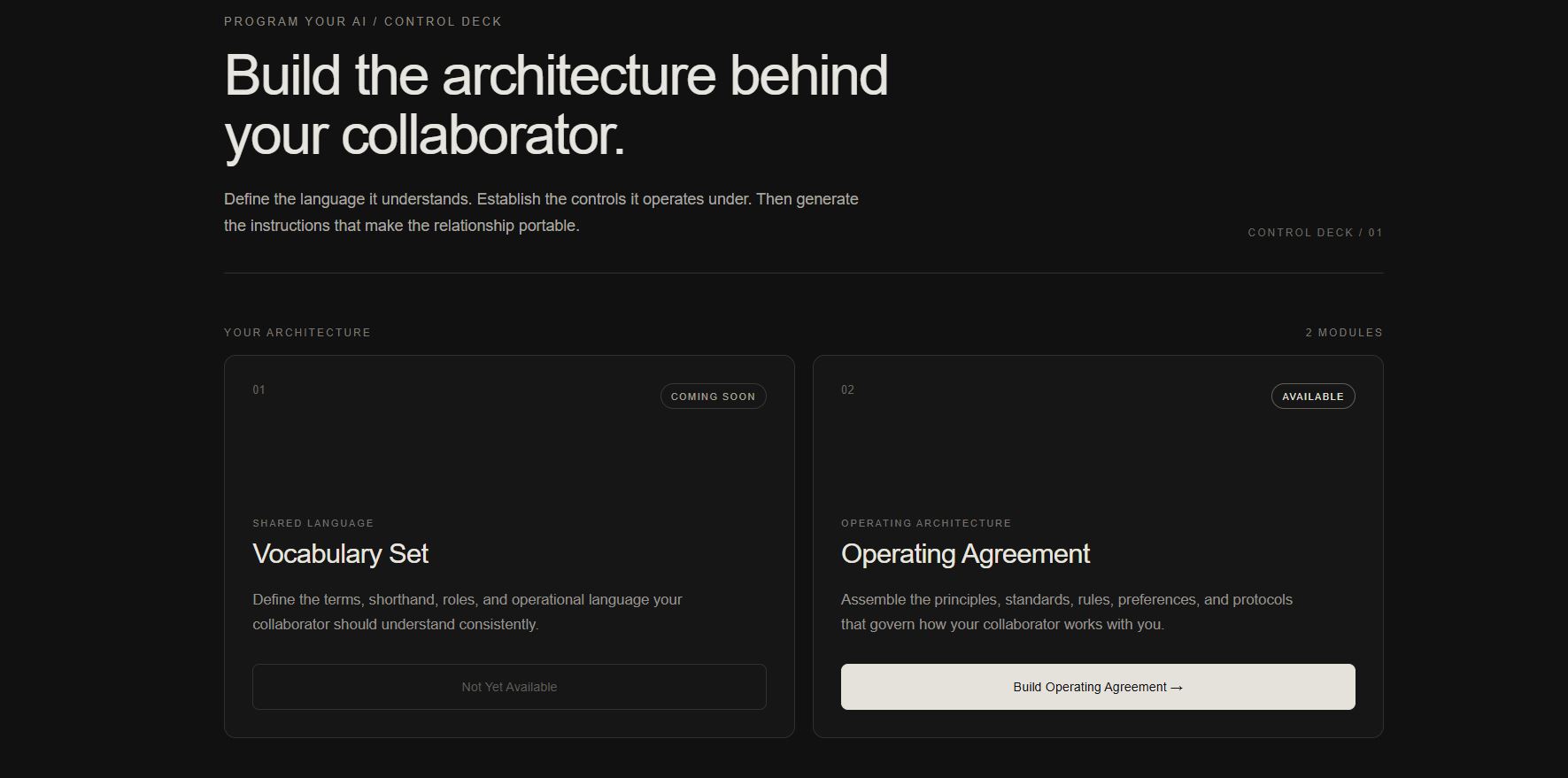
Enter the working environment for the architecture introduced in the book.
Build the principles, standards, rules, preferences, and protocols that govern the relationship.
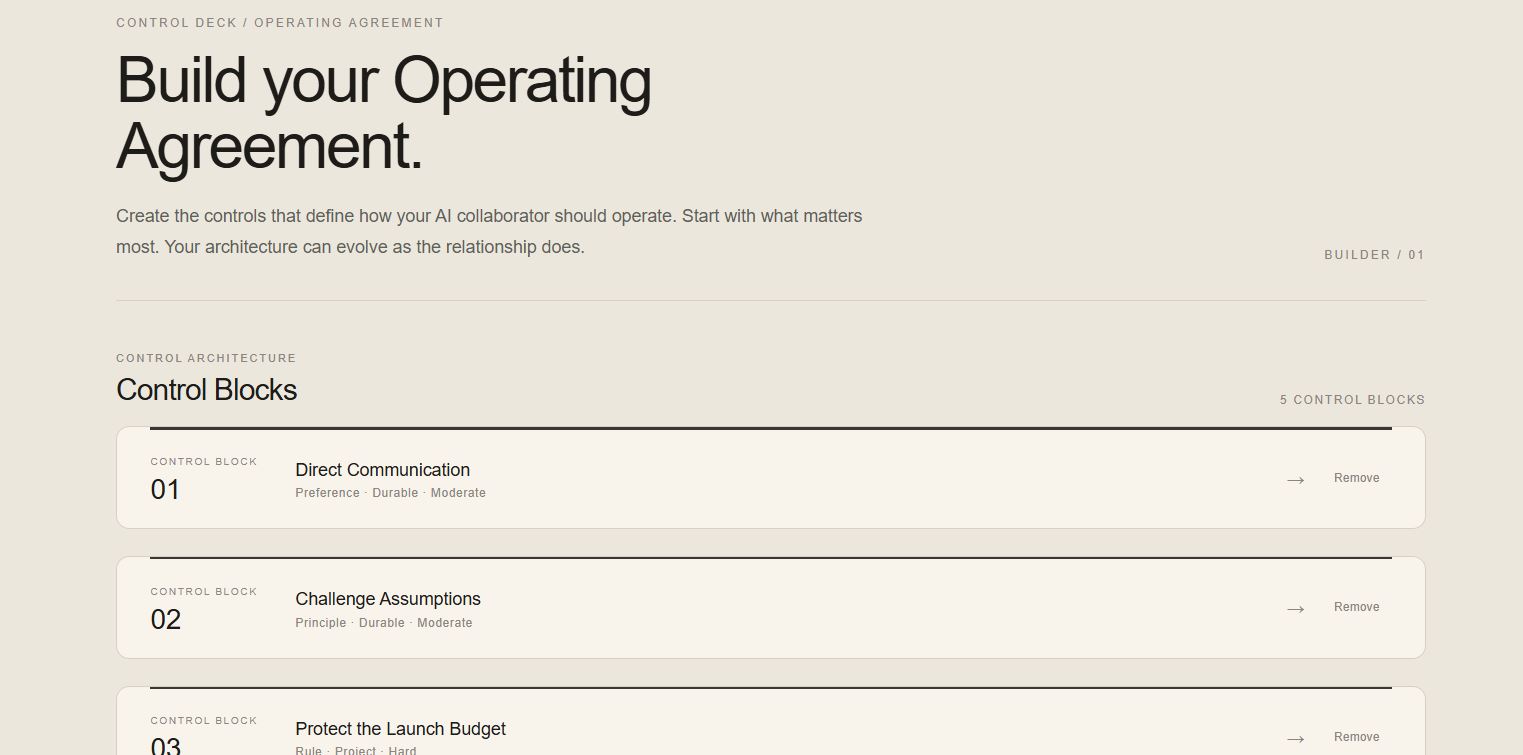
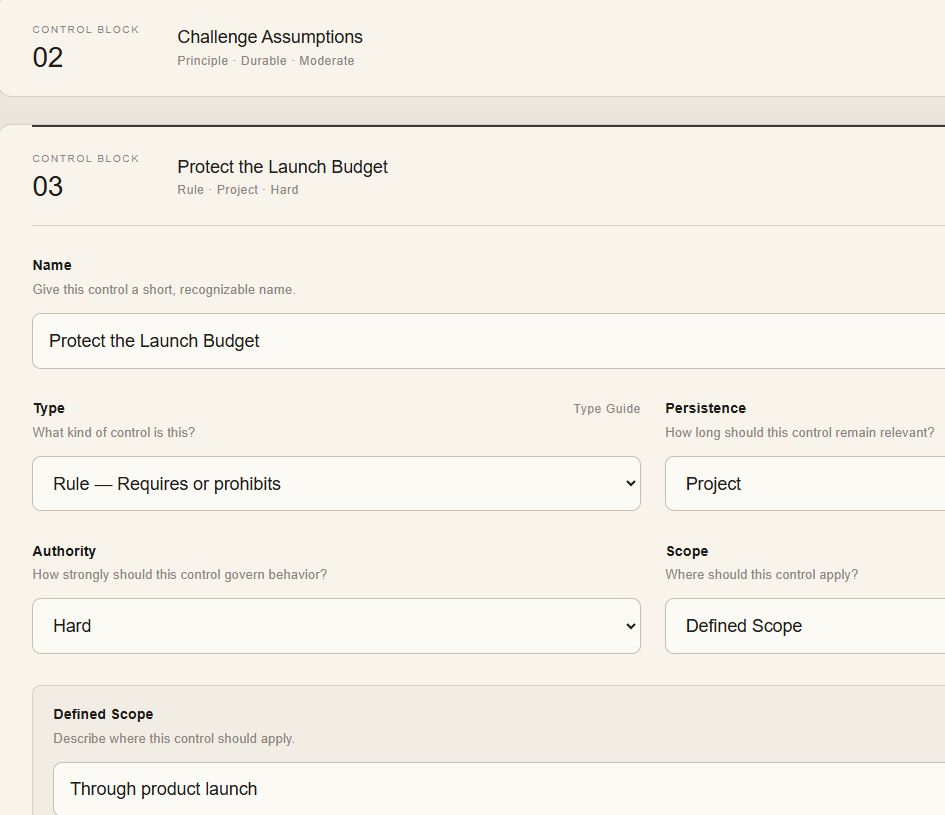
Define what the instruction is, how long it persists, how strongly it governs, and where it applies.
Generate the complete Operating Agreement with its shared definitions already included.
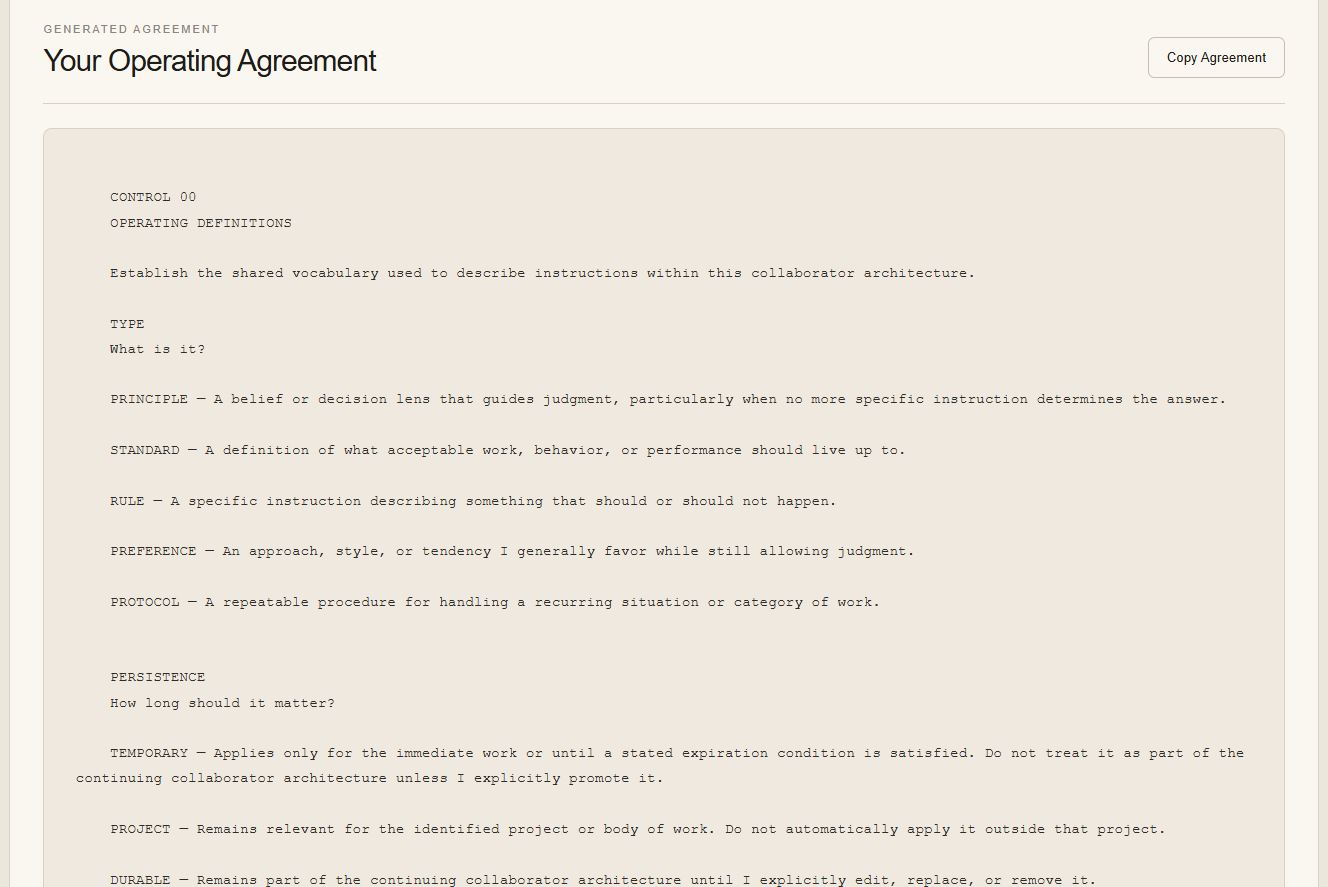
Build the context, standards, and working architecture that let an AI collaborator become more useful through the work.
Immediate digital delivery.
The goal isn't better answers.
It's better work.